
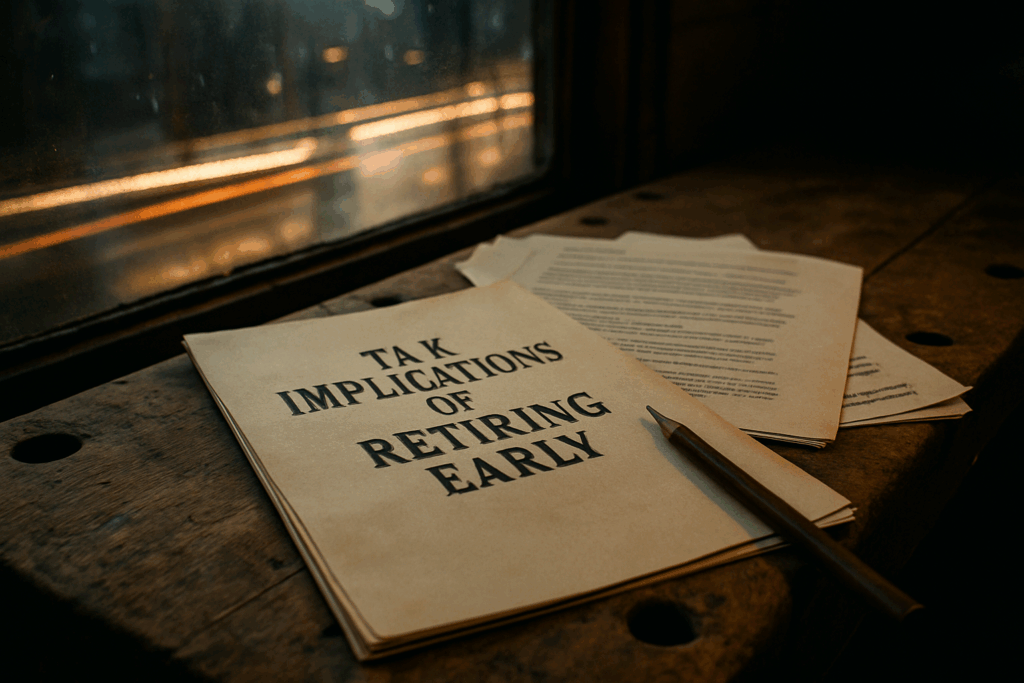
Early Retirement Isn’t Tax Free
Retiring before age 59½ sounds bold and for many, it’s the dream. But the IRS has its own version of reality. If you dip into your 401(k) or traditional IRA too early, there’s a 10% penalty waiting for you on top of regular income taxes. It’s the kind of surprise no one finds amusing.
That said, all is not lost. There are a few legal off ramps from the penalty trap. The Rule of 55, for example, lets you access your 401(k) penalty free if you separate from your employer the year you turn 55 or later. Another option: Substantially Equal Periodic Payments (SEPP), which allows penalty free withdrawals from IRAs though once you start, you have to stick with the formula for at least five years or until age 59½, whichever is longer. Not exactly flexible, but it’s a door in the wall.
And here’s something often overlooked: early retirement means longer retirement. More years of spending without regular income shifts the entire equation. Withdraw too fast, and you inflate your tax burden. Move too cautiously, and you come up short. This is where timing, sequence of withdrawals, and tax slotted strategies come into play.
The lesson? Getting out of the workplace early doesn’t free you from the tax system it just puts you in a new league. One where the rules are different, but still very much in play.
How Lower Income Affects Your Tax Bracket
Retiring early often means dropping into a lower tax bracket. On the surface, that’s great less of your income is taxed. But there’s more going on under the hood. Lower income also changes which deductions you can take and may shrink your eligibility for valuable tax credits. A smaller paycheck can impact your ability to capitalize on deductions tied to income thresholds, like medical expenses or education credits.
One move to consider while your income is down: Roth conversions. You can convert traditional IRA or 401(k) funds into a Roth while paying less in taxes than you might in your peak earning years. Yes, you’re paying tax on those dollars now, but the payoff is tax free growth and withdrawals later especially useful if tax rates rise.
Ultimately, effective tax planning during early retirement often means biting the bullet up front to save more down the line. Sacrificing now, even just a little, can lead to decades of lower taxes. It’s not just about paying less this year it’s about controlling your tax bill across all your retirement years.
Social Security and Medicare Timing Matters

You can start taking Social Security at 62 but that early decision comes with a catch: the check is smaller, permanently. The longer you wait (up to age 70), the bigger the benefit. For early retirees trying to stretch every dollar, this tradeoff matters.
Then there’s healthcare. Medicare doesn’t kick in until 65. If you retire before then, you’ll need to cover the gap yourself. That usually means buying insurance through the Marketplace, and the sticker price can be harsh. But here’s the key Marketplace subsidies are income based. Keep your taxable income low, and you may qualify for major premium reductions.
This makes tax planning critical. Roth conversions, realizing gains, even part time income all of it affects your subsidy eligibility. Retire too early without a plan, and you might get hit with lower Social Security and higher insurance costs. Plan smart, and you can control both levers.
Tax Efficient Withdrawal Strategies
When you’re living off savings, which account you tap first matters in a big way. The general rule of thumb is simple: start with taxable accounts, then move to tax deferred accounts like traditional IRAs and 401(k)s, and save Roth accounts for last. Why? Because Roth money grows tax free and isn’t subject to required minimum distributions (RMDs), giving you long term flexibility.
By spending taxable assets first, you keep your overall taxable income lower in your early retirement years. This might open a window for smart tax moves, like doing partial Roth conversions while staying in a low bracket. It also keeps those tax advantaged accounts compounding untouched for longer.
And don’t forget capital gains. If you’re in a low income year, it might be the right time to harvest gains at a 0% or reduced long term capital gains rate. Likewise, selling investments at a loss to offset other gains called tax loss harvesting can give you a cushion come tax season.
Plan these withdrawals intentionally. It’s not just about funding your lifestyle it’s about managing your tax bill over decades, not just this year.
Planning Ahead is Everything
If you’re aiming for early retirement, your tax plan needs to be as sharp as your exit strategy. You can’t just wing it guessing your way through taxes leads to costly surprises. This is where projection tools, tax software, or a proactive, detail obsessed CPA come into play. These aren’t luxuries; they’re the baseline if you want to avoid unexpected tax bills and stay in control.
Start with a smart monthly budget. Not glamorous, but absolutely necessary. You can’t make informed decisions about how much to withdraw, convert, or reallocate if you don’t have a clear grip on your cash flow. Not sure where to begin? This guide is a solid launch point: How to Create a Monthly Budget That Supports Smart Tax Decisions.
One last truth bomb: Taxes don’t dissolve just because you left the workforce early. In fact, they often become more complicated. Early retirement flips the script you’re not running from taxes, you’re learning to outmaneuver them, year by year.
Final Take: A Strategic Approach Makes Early Retirement Work
Early retirement isn’t just about walking away from your job it’s about stepping into a new financial lifestyle, where every move has tax implications. Those who succeed long term are the ones who treat tax planning as an essential part of their retirement strategy.
The Key to Success: Tactical Planning
A well developed tax strategy can help you avoid unnecessary penalties and preserve your wealth longer.
Early retirees must balance income management, withdrawal timing, and asset allocation with intentional, informed decisions.
Regular tax reviews even in retirement are critical to staying ahead.
Look at the Bigger Financial Picture
Avoid short term thinking. A strategy that saves money this year could cost more over the decades.
Consider a 20 or 30 year timeline when making decisions about withdrawals, investments, and benefits.
Planning across decades helps align income needs with tax efficiency over the long haul.
Every Financial Move Has a Tax Impact
Whether you sell an asset, convert an IRA, take Social Security, or buy health insurance each action has a tax consequence.
Make sure you understand the implications before committing to big financial moves.
When in doubt, consult a CPA or financial planner who specializes in retirement tax planning.
A thoughtful, decade focused approach can transform early retirement from a risky dream into a sustainable, tax smart reality.
 Frankie Drakershopp has opinions about expert tax insights. Informed ones, backed by real experience — but opinions nonetheless, and they doesn't try to disguise them as neutral observation. They thinks a lot of what gets written about Expert Tax Insights, Tax Law Updates and Changes, Personal Finance Advice is either too cautious to be useful or too confident to be credible, and they's work tends to sit deliberately in the space between those two failure modes.
Reading Frankie's pieces, you get the sense of someone who has thought about this stuff seriously and arrived at actual conclusions — not just collected a range of perspectives and declined to pick one. That can be uncomfortable when they lands on something you disagree with. It's also why the writing is worth engaging with. Frankie isn't interested in telling people what they want to hear. They is interested in telling them what they actually thinks, with enough reasoning behind it that you can push back if you want to. That kind of intellectual honesty is rarer than it should be.
What Frankie is best at is the moment when a familiar topic reveals something unexpected — when the conventional wisdom turns out to be slightly off, or when a small shift in framing changes everything. They finds those moments consistently, which is why they's work tends to generate real discussion rather than just passive agreement.
Frankie Drakershopp has opinions about expert tax insights. Informed ones, backed by real experience — but opinions nonetheless, and they doesn't try to disguise them as neutral observation. They thinks a lot of what gets written about Expert Tax Insights, Tax Law Updates and Changes, Personal Finance Advice is either too cautious to be useful or too confident to be credible, and they's work tends to sit deliberately in the space between those two failure modes.
Reading Frankie's pieces, you get the sense of someone who has thought about this stuff seriously and arrived at actual conclusions — not just collected a range of perspectives and declined to pick one. That can be uncomfortable when they lands on something you disagree with. It's also why the writing is worth engaging with. Frankie isn't interested in telling people what they want to hear. They is interested in telling them what they actually thinks, with enough reasoning behind it that you can push back if you want to. That kind of intellectual honesty is rarer than it should be.
What Frankie is best at is the moment when a familiar topic reveals something unexpected — when the conventional wisdom turns out to be slightly off, or when a small shift in framing changes everything. They finds those moments consistently, which is why they's work tends to generate real discussion rather than just passive agreement.